


Before you reply to that WhatsApp message, spend five minutes learning how to check UAE job offer is real. Every month, somebody lands in Dubai or Abu Dhabi with a printed "offer letter", a suitcase, and a Telegram contact who has stopped replying. No job. No refund. Sometimes no return ticket either. It's an ugly story, and it repeats so often that UAE authorities now issue public warnings about it.
This guide is for everyone, from the person getting their very first offer to the HR veteran who thinks they've seen it all. Read it slowly. Then forward it to the cousin who is "about to send the visa fee".

Why fake UAE job offers work so well
The UAE is a dream destination for a huge number of job seekers, and scammers know that. Tax-free salaries, big-brand employers, fast-growing cities. Put a famous company logo on a letter and half the verification instinct in your brain switches off.
Fake offers usually start with an ad on social media, a job website, or a messaging app. Scammers copy the name, logo, and style of a real company, so the whole thing looks believable at first glance. A logo can be copied in thirty seconds. Remember that line, because we'll come back to it.
The 5-minute check (beginners start here)
If you only have five minutes, do these four things before you reply, pay, or share anything personal:
- Find the job on the company's own careers page (not the link the recruiter sent you, the page you typed in yourself)
- Ask for the official job offer and look for a serial number or barcode on it
- Search the company name in the UAE National Economic Register
- Never send money. Ever. Not even "just a small processing fee"
That is the skeleton. The rest of this article puts meat on it.
Red flag 1: they ask you for money
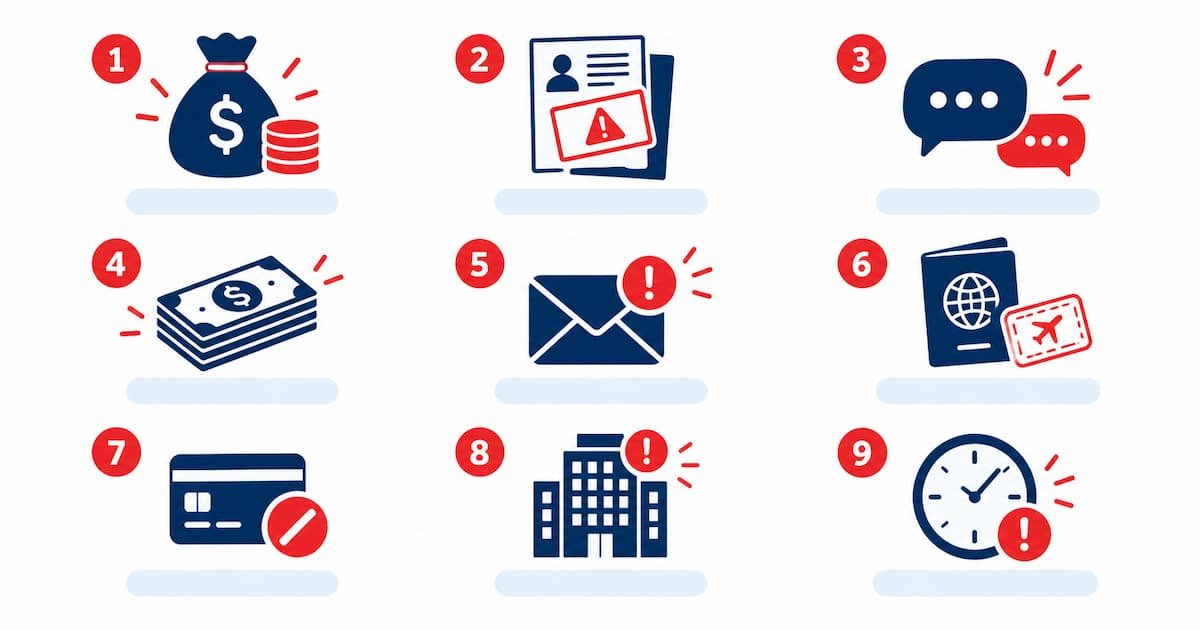
This is the big one, the loudest alarm in the building. Under UAE labour law, employers cannot charge workers recruitment and employment costs, directly or indirectly. So the visa fee, the medical, the "file processing", the "security deposit", the "ticket advance" — all of it is the employer's bill.
Careful here, because there is a grey area people argue about. Some agents back home do charge their own service fees in the worker's country. That's a separate conversation, and the rules differ by country. But if the money is for the UAE visa, the permit, or "guaranteeing" the job itself, treat it as a scam until proven otherwise. Highly unlikely to be real.
Red flag 2: the offer isn't on the official MOHRE form
A genuine offer for a private-sector job is issued through MOHRE (the Ministry of Human Resources and Emiratisation) on its approved job offer form. That form carries a unique serial number or barcode.
So what you want is simple. A random PDF with a pretty header and a signature scribble is not the same thing. Ask for the MOHRE-approved offer, check the barcode, and move on if they dodge the question. A company that really wants to hire you will not be offended by a verification request. Actually, scratch that, they'll expect it.
Red flag 3: you were "hired" without a real interview
Got a job after a ten-minute WhatsApp chat? No video call, no technical questions, nobody asking for a work sample? Hmm.
Real employers, even rushed ones, want to know you can do the job. Scam recruiters want your documents and your money, and your skills are irrelevant to them. Fast hiring, instant selection, and "you don't even need experience" are the sort of promises MOHRE has specifically warned about.
Red flag 4: the salary looks too good for the role
A fresh graduate offered a salary that experienced managers would envy. A data entry job paying like a senior engineer. Think about it.
Salaries in the UAE do vary a lot by industry, so a high number alone proves nothing. The warning sign is the mismatch: big pay, tiny requirements, zero questions. Compare the figure against two or three genuine listings for the same title (our [Insert Internal Link: UAE salary guide] is a decent starting point).
Red flag 5: the email domain feels wrong
Look at the sender's address like a detective, not like a hopeful applicant.
- Gmail, Yahoo, or Outlook addresses claiming to be "HR at" a large corporation
- Lookalike domains, where one letter is swapped, or a hyphen sneaks in (companyname-careers.com instead of companyname.com)
- A recruiter name that doesn't match the signature, the LinkedIn profile, or the email itself
- No phone number
Open the company's real website in a fresh tab, find the official HR email format, and compare. Takes two minutes. Saves a lot of regret.
Red flag 6: "come on a visit visa, we'll convert it"
Pro-level warning, and one of the most expensive mistakes on this list. MOHRE has said clearly that a tourist or visit visa does not give you the right to work in the UAE. A genuine employer arranges an electronic work entry permit after you sign the offer, and residency visas can't be processed outside the UAE without that entry route.
Anyone telling you to fly in first and "sort the paperwork later" is either careless or planning to disappear. Either way, it isn't your problem to solve with your savings.
Red flag 7: personal and banking details too early
Passport copies and certificates are normal at some point in hiring. Bank card numbers, PINs, and OTP codes are never normal. Not for onboarding, not for "salary account activation", not for anything.
Dubai Police have also warned about fake part-time jobs where victims were pushed into opening bank accounts that criminals then used to move illegally obtained money. You think you've got a job; in reality, you've become a middleman in a crime. Which brings me back to my first point: if money moves through you, walk away.
Red flag 8: the company is a ghost
Search for the business. Does it have an office address you can find on a map? A phone line that connects to an actual human? A page in the UAE National Economic Register? A careers page that lists your role?
None of that? Then you're talking to a name, not a company.
Free zone companies add a small twist (their licences come from the free zone authority, not the mainland departments), so the register may not be your only check there. Ask for the trade licence number and verify it with the relevant authority. Real companies hand it over without drama.
Red flag 9: pressure, secrecy and countdown timers
"Offer expires in 2 hours." "Don't tell other recruiters." "Pay today, or we give your seat away."
Pressure is a tool, and scammers love it because panic kills verification. A real employer will give you a few days to read a contract, ask questions, and talk to your family. Secrecy requests (don't tell anyone, don't contact the embassy, don't call the ministry) are the loudest alarm of all.
How to verify a UAE job offer step by step (pro level)
Okay, you've dodged the obvious traps. Now do the proper verification.
Step 1: Check the offer through MOHRE
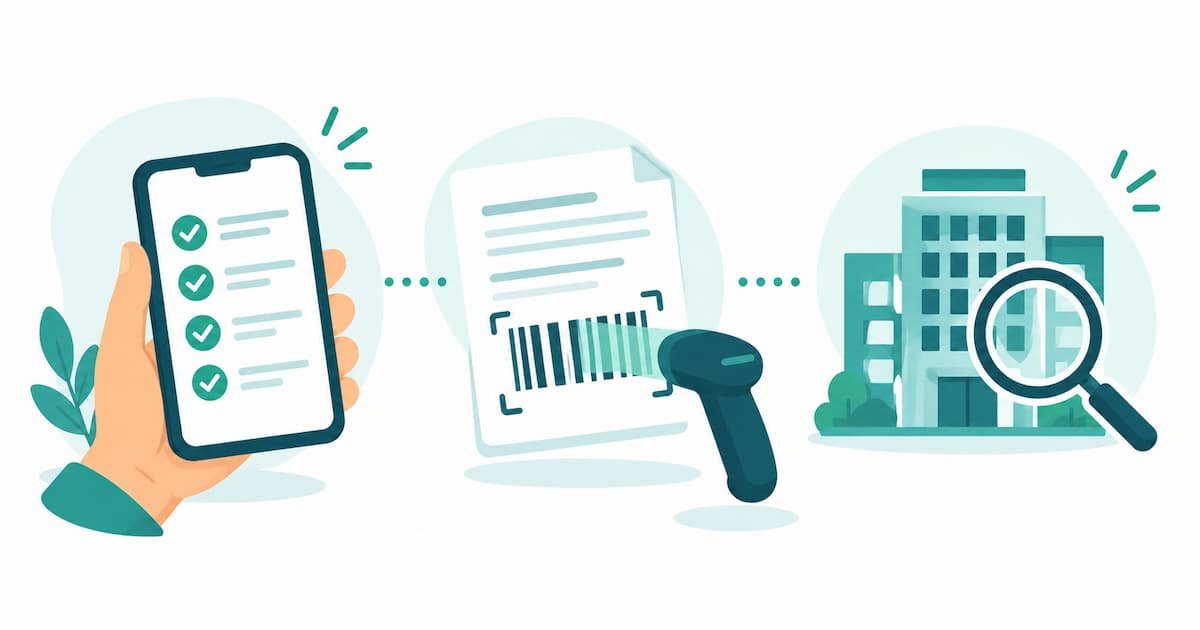
Take the serial number or barcode from the offer and verify it on the MOHRE website, the MOHRE UAE smart app, or the call centre at 600590000. The website also has an Application Status Inquiry where you can check an offer number. Application Status Inquiry
Step 2: confirm the company exists
Search the company in the UAE National Economic Register and match the details: name, activity, location. If anything looks different from what the recruiter told you, ask why, calmly, in writing.
Step 3: Look for the entry permit logic
After you sign a genuine offer, the employer issues an electronic work entry permit so you can travel legally. No permit, no flight. Simple rule, I know, but people break it all the time.
Step 4: Use the embassy or consulate
Embassy officials can help verify whether an offer is genuine, so don't feel shy about contacting yours. It's free, and it's literally their job.
Step 5: Read the contract as it matters
Salary, job title, working hours, probation, leave, notice period. Make sure what's written matches what was promised on the phone. If a point is missing, ask for it in writing.
What a real UAE job offer usually looks like
Not an exact checklist (companies differ), but a genuine offer typically has:
- the MOHRE-approved form with serial number/barcode
- authorised employer signature
- job title, salary, benefits
- company name and licence details that match public records
- no fee demands
If three of those five are missing, pause.
What to do if you already paid or shared documents
First, stop sending anything else. Don't pay "one last fee" to release the money you already paid. That second payment is part of the trick.
Then gather the evidence: chats, screenshots, payment receipts, phone numbers, email headers, the fake offer letter. Report it to MOHRE and to the police cybercrime channel in your emirate (Dubai residents can use the eCrime platform). UAE Government portal – report a cybercrime. If you shared bank details, call your bank immediately and block the cards. If you're abroad, tell your embassy too.
Will you get the money back? Honestly, it's hard to say. But fast reporting improves the odds and helps stop the next victim, and that part matters.
Quick pre-offer checklist you can screenshot
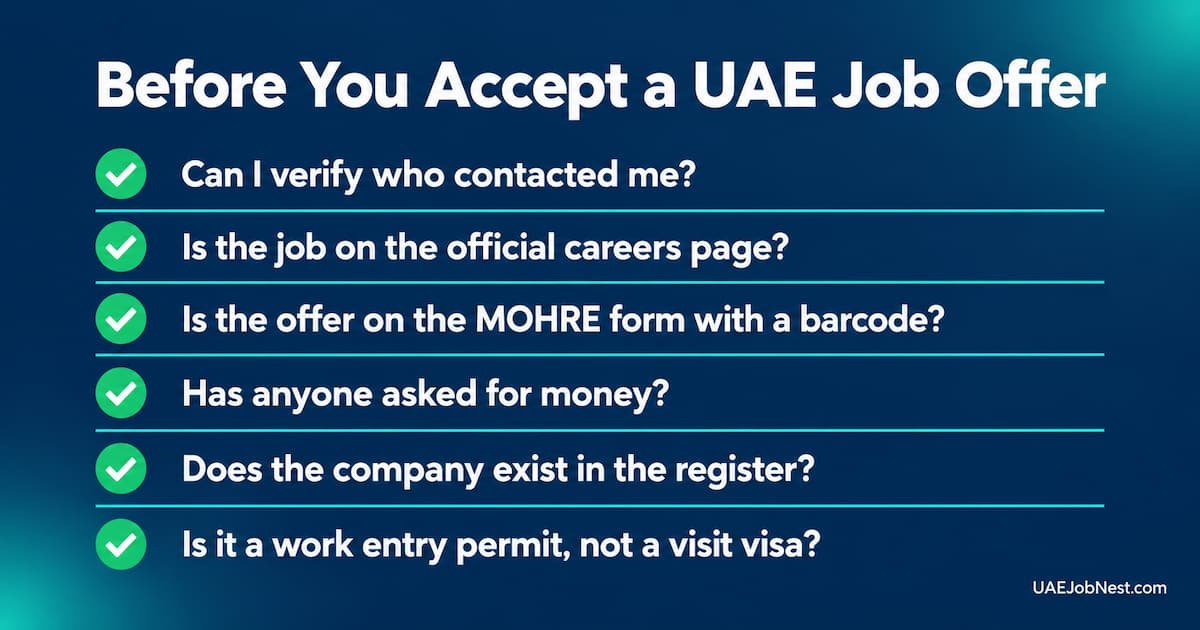
- Who contacted me, and can I check them independently
- Is the job on the official careers page
- Is the offer on the MOHRE form with a barcode
- Has anyone asked for money (if yes, stop)
- Does the company exist in the register
- Is the visa route a work entry permit, not a visit visa
Six lines. Keep them on your phone.
Frequently asked questions
How can I check if a UAE job offer is real?
Take the serial number or barcode printed on the offer and verify it through the MOHRE website, the MOHRE UAE smart app, or the call centre on 600590000. Then search the company name in the National Economic Register. If either check fails, don't send money or documents.
Can a UAE employer ask me to pay for my visa?
No. Under UAE labour law, recruitment and employment costs belong to the employer, not the worker, whether charged directly or sideways through an agent. If someone asks you to pay for the visa, permit, or "job guarantee", treat it as a scam until proven otherwise.
Can I work in the UAE on a visit or tourist visa?
No. A visit visa does not give you the right to work. A genuine employer arranges an electronic work entry permit after you sign the offer, and you travel on that.
Is a job offer on WhatsApp or Telegram real?
Hard to say from the app alone, since real recruiters do use messaging apps for quick updates. What matters is what comes with the chat: a MOHRE-approved offer with a barcode, a company you can verify, and no request for money. A chat with none of those is just a chat.
What should I do if I already paid a fake recruiter?
Stop sending anything else, including "one last fee". Save chats, screenshots, and receipts, report it to MOHRE and to the cybercrime channel of your emirate's police, and call your bank if you shared card details. If you're abroad, tell your embassy too.
Does a real company logo on the offer letter prove it's genuine?
Not at all. Logos get copied in seconds. Always verify the offer itself, not the branding around it.
Final thoughts
The UAE has plenty of real jobs and plenty of honest employers, so please don't read this and decide everything is a scam. Most offers are fine. The trick is that verification is free and takes minutes, while a scam can cost you months of savings, or more. Check first, trust second.
No comments yet — be the first to share your thoughts on this post.