

The salary didn't land on the 1st. Then the 5th passed too. By the 12th, you've stopped refreshing your banking app and started doing rent math instead.
If that's you, a MOHRE salary complaint is the official route to getting paid, and it costs nothing to file. This guide covers how to file, what happens next, and the dates that can quietly kill your claim.
When does a salary count as late now?
This part changed recently, so read it even if you've filed before.
From June 1, 2026, private-sector salaries for the previous month are due on the first day of the following month. For example, May wages were due on June 1. Anything paid after that date is treated as delayed. Older rules gave employers a 15-day cushion before a delay was formally recorded, and the reporting on the new rules suggests that cushion is gone.
MOHRE also set out a phased pressure timeline for employers who pay late:
- From day 2: electronic monitoring and warning notices
- Day 5: restrictions on new work permits for the company
- Around day 11: fines and a possible classification downgrade (mostly aimed at repeat offenders within six months)
- Day 16: MOHRE may register labour disputes on workers' behalf, and tighter measures kick in for larger employers and high-risk sectors
- Day 21 and beyond, repeat violations at bigger companies can lead to prosecution referrals, asset seizures and travel bans on responsible officials
Sounds satisfying, doesn't it? Here's the catch. All of that is pressure on the company. It doesn't automatically put money in your account, and a company can sit in "warning" status for a while. Your own complaint is still the thing that turns a late salary into an enforceable claim.
One more detail. MOHRE introduced an 85 percent rule: if at least 85 percent of wages are paid on time and the rest is a legally documented deduction (a loan, an absence deduction), the worker isn't classified as unpaid. That's about how the payroll system labels you, as far as I can tell. Whether a deduction was actually lawful is a separate question, and you're allowed to ask it.
Get your paperwork ready first
You can file with whatever you have, so don't stall for a perfect folder. But a tidy file helps the officer understand your case in two minutes instead of twenty.
- Employment contract (or offer letter, if the contract is missing)
- Bank statements or WPS payslips showing what you were actually paid, with dates visible
- Emirates ID and passport details
- Any WhatsApp messages or emails where HR admits the delay or promises a date (screenshots with the date showing, please, not cropped fragments)
- Short timeline of what was due and when
Write down the exact amount you're claiming too. That number matters more than people expect, and I'll get to why in a moment.
How to file a MOHRE salary complaint, step by step
Online or through the app
Three official channels exist for filing and tracking: the MOHRE website, the MOHRE UAE app, and the phone line. The online route is the quickest for most people. MOHRE official website.
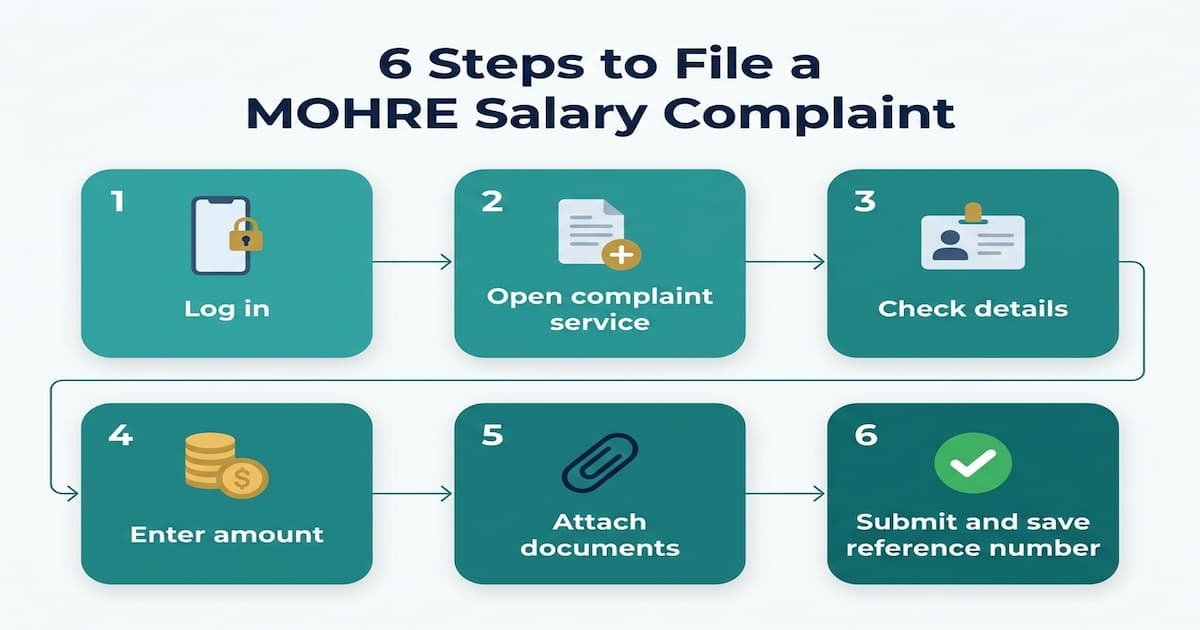
- Log in to the MOHRE website or app. Most guides mention UAE Pass for this step, though the app will tell you if it wants something else.
- Open the employee services section and choose the labour complaint service.
- Check your personal details and your employer's details.
- Answer whether your current salary matches your contract. Tell the truth, even if the real figure is lower.
- Pick the complaint type (late or unpaid wages), enter the amount, and describe the problem in a few plain sentences.
- Attach your documents, submit, and save the reference number somewhere you won't lose it.
Don't write an essay in the description box. Dates, amounts, what the employer said. That's it.
By phone
Call the Labour Claims and Advisory Centre on 80084. The government portal also lists 600 590 000. Phone is fine if the app confuses you, and honestly, plenty of people get stuck on step 4. Nobody's judging.
What happens after you submit
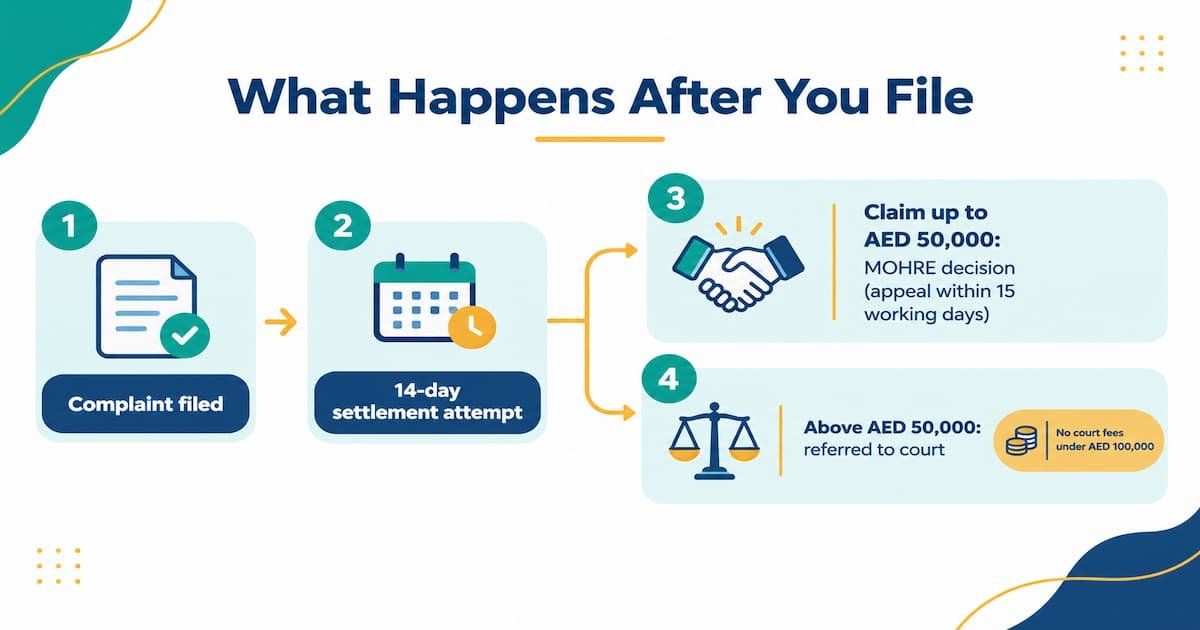
MOHRE contacts you and your employer and tries to settle things amicably within 14 days. This stage does most of the heavy lifting. MOHRE's own figures say it settled 98.6 percent of private-sector labour disputes in 2025 without sending them to court, which means the courtroom scenario is the exception, not the rule.
If no settlement happens, the path depends on the claim size:
- Claim up to roughly AED 50,000: MOHRE can issue a final, enforceable decision itself, and either side can appeal to the Court of Appeal within 15 working days of being notified
- Above that, with no agreement: MOHRE refers the case to court with a memo summarising the dispute and both sides' evidence
- Settled amicably? That settlement can be enforced, whatever the amount
Is a claim of exactly AED 50,000 inside or outside the line? The government portal says "less than" and some news reports say "not more than." I wouldn't guess. Ask 80084 before you finalise the number.
If the case goes to court, you must register it within 14 days of the referral being approved, and the court is supposed to fix a hearing within three days of receiving it. Court fees are waived at every stage for workers whose claims are below AED 100,000. UAE Government Portal labour disputes page
Mistakes that cost people their money
Waiting is the big one. Claims for rights due are not heard after one year from the date of the violation (Article 10 of the labour law). Remember the amount I told you to write down? Same logic: a vague, undated complaint is easy to dispute. If several months are unpaid, assume the oldest month's clock is already ticking. I'm not a lawyer, so for anything borderline, check with MOHRE or a licensed legal adviser.
Working elsewhere while your case is in court is another trap. A worker whose complaint has been referred to court shouldn't take another job without a temporary work permit from MOHRE. And if you stop working because of the dispute, your permit can be cancelled six months after the referral. UAE visa cancellation grace period
Then there's the verbal promise. HR says, "money comes Friday, please withdraw." You can withdraw a complaint any time before a final decision, which is exactly why the smart move is waiting until the money is actually in your account. Think about it.
Two edge cases deserve a quick check before you file. Free zone employees often have their own dispute route, so confirm which authority applies to you. Domestic workers go through a separate MOHRE channel. Beyond that? Another story entirely.
So, should you file?
If your salary is late and the employer has gone quiet, yes. File now, not "after the next payday." The process is free, the first stage is short, and most cases end there. The rules around payment deadlines also changed this year, so double-check the official channels for the latest version before you submit.
No comments yet — be the first to share your thoughts on this post.